

Black ink or Red ink?
This question was looking for the wrong response. One of the possible answers had red ink being allowed on applications. I only found black ink pen requirements in the MPEP. I answered that red ink was the wrong response.
top
Museum Titanium Baseball Question
This question concerned an article about a special titanium baseball put on public display in a museum. The issue is: is it public use if only "wealthy museum patrons who have no interest or skill to make baseballs" see it? Or is it public use when the general public see it, or people who have the interest/skill to make baseballs can see it? In other words, the main question is: is something public use if ONLY the people having skill in the art can see it? 8/10/2007 The fact pattern for this question, when I had it, was as follows: Article is published on Date 1 though not distributed. Article is put on display at museum on Date 2, museum is only accessed at this time by wealthy museum patrons who don't have the skills to make baseballs (but the museum is a baseball museum). On Date 3, museum has a big PR event with news media etc. On Date 4, articles in museum are indexed and sorted. which date is the prior art date of the publication?
See MPEP 2133.03(a)A.(2.), In Re Blaisdell, Ex Parte Kuklo. "The person to whom the invention is publicly disclosed need not understand the significance and technical complexities of the invention."
A key to this question is also understanding that if a publication is only viewed by a few select members of the musuem club, then it is not PUBLIC and therefore does NOT qualify as a 102(a) or 102(b) publication. It doesn't matter if it is properly shelved and catalogued.
top
Mirror Question
There is one question discussing the use of "mirror" in the claims and whether its "reflective qualities" should be discussed in the specification. You were to choose from a list of choices a single answer that comported with USPTO practice and procedure. Among the answers: (A) because the definition of mirror automatically includes its reflective qualities, there is no need to amend the specification to include the reflective qualities (E) the mirror in one part of the specification is "parallel," and the mirror in another part is "perpendicular," the specification is conflicting and one who has knowledge in the art would not be able to tell the difference so you amend the specification.
I would select (A) based on 2163.07(a) Inherent Function, Theory, or Advantage. Reflection is an inherent function of a mirror, so there is no need to mention it in the description.
top
Tribell Question
A question involving the inventor Tribell, but with the name periodically swapped out with another name.
This is related to reissue.
There is a reissue question for an inventor Tribell in Question 16 of the Oct 2003 AM exam. The answer is to file a reissue to broaden the claims, but no divisional reissue can be filed because not claiming restricted claims is not an "error" that can be considered in a reissue application. See MPEP 1402, Grounds for Filing.
top
Amending Abstract
A question about amending the abstract. The answer is that the examiner will not supply one if it is absent.
- In 608.01(b) Abstract of the Disclosure
- The Office of Initial Patent Examination (OIPE) will review all applications filed under 35 U.S.C. 111(a) for compliance with 37 CFR 1.72 and will require an abstract, if one has not been filed. In all other applications which lack an abstract, the examiner in the first Office action should require the submission of an abstract directed to the technical disclosure in the specification. See Form Paragraph 6.12 (below). Applicants may use either “Abstract” or “Abstract of the Disclosure” as a heading.
If the application is otherwise in condition for allowance, examiner should make any necessary revisions: In 608.01(b) "Upon passing the application to issue, the examiner should make certain that the abstract is an adequate and clear statement of the contents of the disclosure and generally in line with the guidelines. If the application is otherwise in condition for allowance except that the abstract does not comply with the guidelines, the examiner generally should make any necessary revisions by a formal examiner's amendment after obtaining applicant's authorization (see MPEP § 1302.04 rather than issuing an Ex parte Quayle action requiring applicant to make the necessary revisions."
top
Obviousness
One obviousness question and all the answers seemed incorrect. Only one involved teaching or motivation even though another answer was in better form.
- 2144.05 III. REBUTTAL OF PRIMA FACIE CASE OF OBVIOUSNESS
- A prima facie case of obviousness may also be rebutted by showing that the art, in any material respect, teaches away from the claimed invention.
top - A prima facie case of obviousness may also be rebutted by showing that the art, in any material respect, teaches away from the claimed invention.
Deleting Benefit Claim
Two questions on how to extend your patent life by deleting a claim of benefit. If you didn't realize the answer to the first was file an RCE the second question does it in the fact pattern and calls it 'proper'. But in the second question, which is tougher, you have to realize the 4 months/16 months deadlines (see 1.55(a) and 1.78(a)(2)(ii)), figure out they are exceeded, and realize that because the applicant removed the claim himself he cannot avail himself of adding the claim as unintentional (applicant gets screwed because a new ground of rejection is applied after he withdraws his claim and he has no way to put the claim back).
- In 201.11 G. Deleting Benefit Claims
- As a result of the 20-year patent term, it is expected, in certain circumstances, that applicants may cancel their claim to priority by amending the specification or submitting a new application data sheet (no supplemental declaration is necessary) to delete any references to prior applications. [...]
- A cancellation of a benefit claim to a prior application may be considered as a showing that the applicant is intentionally waiving the benefit claim to the prior application in the instant application. If the applicant later files a petition to accept an unintentionally delayed claim to add the benefit claim to the prior application in the same application from which the benefit claim was canceled, the Office may refuse to accept such benefit claim because the delay was not unintentional.
top - As a result of the 20-year patent term, it is expected, in certain circumstances, that applicants may cancel their claim to priority by amending the specification or submitting a new application data sheet (no supplemental declaration is necessary) to delete any references to prior applications. [...]
PCT / National Stage
Questions on what to submit when entering the national stage in case USPTO was the receiving office of the international application. Answer is to pay the fee because if you file with the USPTO as an RO you do not need to submit the application or wait for it to be transferred from IB.
- In 1893.01(a)(1) Submissions Required by 30 Months from the Priority Date
- Where the international application was filed with the United States Receiving Office as the competent receiving Office, the copy of the international application referred to in 37 CFR 1.495(b) is not required. Payment of the basic national fee will indicate applicant's intention to enter the national stage and will provide a U.S. correspondence address in most instances.
-Question on what can be faxed in PCT entering the stage in US -MPEP 1834.01 (Use of Telegraph, Teleprinter, or Facsimile machine) - can't file PCT application or copy of application and fee to enter natl stage by fax.
-Question on what USPTO will do if: Japanese citizen currently residing in US files PCT application with USPTO but application is in Japanese - the choices were as follows:
1. not given a filing date
2. sent to International Bureau for processing
3. sent to Japanese PTO
4. can't remember the last choice!!
-the correct answer can be found in section 1805 on page 1800-7 2nd column, 3rd paragraph. US will forward application to International bureau for processing if PCT filed using USPTO but application not in English or applicant not resident/citizen of US at the time. Date of US filing will be date given the PCT application by the International Bureau - if all other requirements met.
top
102(e) / PCT applications
- One question on 102(e) with a date of 1998 so that the reference date of the patent is when it completed requirements under 371(c).
- PCT designating USA filed in English claiming priority to JP application. Filing date was after Nov 29, 2000. IA published in English, and entered the National Stage. US application publication was published. Subsequently, the application was patented. When is the 102(e) prior art date?
- In 2136 35 U.S.C. 102(e)
- Revised 35 U.S.C. 102(e) allows the use of certain international application publications and U.S. patent application publications, and certain U.S. patents as prior art under 35 U.S.C. 102(e) as of their respective U.S. filing dates, including certain international filing dates. The prior art date of a reference under 35 U.S.C. 102(e) may be the international filing date if the international filing date was on or after November 29, 2000, the international application designated the United States, and the international application was published by the World Intellectual Property Organization (WIPO) under the Patent Cooperation Treaty (PCT) Article 21(2) in the English language. See MPEP § 706.02(f)(1) for examination guidelines on the application of 35 U.S.C. 102(e).
- (1) If the international application meets the following three conditions:
- (a) an international filing date on or after November 29, 2000;
- (b) designated the United States; and
- (c) published under PCT Article 21(2) in English,
- then the international filing date is a U.S. filing date for prior art purposes under 35 U.S.C. 102(e).
- Revised 35 U.S.C. 102(e) allows the use of certain international application publications and U.S. patent application publications, and certain U.S. patents as prior art under 35 U.S.C. 102(e) as of their respective U.S. filing dates, including certain international filing dates. The prior art date of a reference under 35 U.S.C. 102(e) may be the international filing date if the international filing date was on or after November 29, 2000, the international application designated the United States, and the international application was published by the World Intellectual Property Organization (WIPO) under the Patent Cooperation Treaty (PCT) Article 21(2) in the English language. See MPEP § 706.02(f)(1) for examination guidelines on the application of 35 U.S.C. 102(e).
- 706.02(f)(1)
- (3) If the international application has an international filing date prior to November 29, 2000, apply the reference under the provisions of 35 U.S.C. 102 and 374, prior to the AIPA amendments:
- (a) For U.S. patents, apply the reference under 35 U.S.C. 102(e) as of the earlier of the date of completion of the requirements of 35 U.S.C. 371(c)(1), (2) and (4) or the filing date of the later filed U.S. application that claimed the benefit of the international application;
- (b) For U.S. application publications and WIPO publications directly resulting from international applications under PCT Article 21(2), never apply these references under 35 U.S.C. 102(e). These references may be applied as of their publication dates under 35 U.S.C. 102(a) or (b);
- (c) For U.S. application publications of applications that claim the benefit under 35 U.S.C. 120 or 365(c) of an international application filed prior to November 29, 2000, apply the reference under 35 U.S.C. 102(e) as of the actual filing date of the later-filed U.S. application that claimed the benefit of the international application.
top - (3) If the international application has an international filing date prior to November 29, 2000, apply the reference under the provisions of 35 U.S.C. 102 and 374, prior to the AIPA amendments:
Suspended Practitioner
Question on suspended practitioner. Is one of the "which one is incorrect" type. Know that the USPTO will not "ad litem" appoint a new practitioner if the one in the power of attorney is suspended.
- 105 Suspended or Excluded Practitioner Cannot Inspect [R-2]
- U.S. Patent and Trademark Office (USPTO) employees are forbidden to hold either oral or written communication with an attorney or agent who has been suspended or excluded from practice by the USPTO regarding an application unless it *>is< one in which said attorney or agent is the applicant. Power to inspect given to such an attorney or agent will not be accepted.
top - U.S. Patent and Trademark Office (USPTO) employees are forbidden to hold either oral or written communication with an attorney or agent who has been suspended or excluded from practice by the USPTO regarding an application unless it *>is< one in which said attorney or agent is the applicant. Power to inspect given to such an attorney or agent will not be accepted.
Digital Media for Gene Sequence
Question about how many and what kind of digital media you have to submit with a gene sequence.
- 2421.02 Summary of the Requirements of the Sequence Rules
- Basically, the sequence rules define a set of symbols and procedures that are both mandatory and the only way that an applicant is permitted to describe information about a sequence that falls within the definitions used in the rules. Thus, 37 CFR 1.821 defines a “sequence” and a “Sequence Listing” for the purpose of the rules, the requirements for specific symbols, and formats for the “Sequence Listing,” the requirement for a computer readable form (CRF) of the “Sequence Listing,” and the deadlines for complying with the requirements. 37 CFR 1.822 to 37 CFR 1.824 set forth detailed descriptions of the requirements that are mandatory for the presentation of sequence data, and 37 CFR 1.825 sets forth procedures that are available to an applicant in the event that amendments to the sequence information or replacement of the computer readable copy become necessary. The sequence rules embrace all unbranched nucleotide
- § 1.824 Form and format for nucleotide and/or amino acid sequence submissions in computer readable form.
- (a) The computer readable form required by § 1.821(e) shall meet the following requirements:
- […]
- (1) Diskette: 3.50 inch, 1.44 Mb storage; 3.50 inch, 720 Kb storage; 5.25 inch, 1.2 Mb storage; 5.25 inch, 360 Kb storage.
- (2) Magnetic tape: 0.5 inch, up to 24000 feet; Density: 1600 or 6250 bits per inch, 9 track; Format: Unix tar command; specify blocking factor (not “block size”); Line Terminator: ASCII Carriage Return plus ASCII Line Feed.
- (3) 8mm Data Cartridge: Format: Unix tar command; specify blocking factor (not “block size”); Line Terminator: ASCII Carriage Return plus ASCII Line Feed.
- (4) Compact disc: Format: ISO 9660 or High Sierra Format.
- (5) Magneto Optical Disk: Size/Storage Specifications: 5.25 inch, 640 Mb.
top - (1) Diskette: 3.50 inch, 1.44 Mb storage; 3.50 inch, 720 Kb storage; 5.25 inch, 1.2 Mb storage; 5.25 inch, 360 Kb storage.
- (a) The computer readable form required by § 1.821(e) shall meet the following requirements:
Signature on 1.132 petition
Question asking who can sign a 1.132 petition showing that a previous invention was not by another. The subject matter of the question is "Application A" and "Patent X". The answer choices included variations of: declarations or statements from -the owner of Application A, the inventor of Application A, the inventor of Patent X, the attorney, and there was another choice. 2 answers were accepted because the inventor is in a position to have the best knowledge of ownership of the invention - or something along those lines - but the original correct answer was the attorney can send in a statement. I marked that answer on the exam.
- 37 CFR 10.18. Signature and certificate for correspondence filed in the Patent and Trademark Office.
- (a) For all documents filed in the Office in patent, trademark, and other non-patent matters, except for correspondence that is required to be signed by the applicant or party, each piece of correspondence filed by a practitioner in the Patent and Trademark Office must bear a signature, personally signed by such practitioner, in compliance with § 1.4(d)(1) of this chapter.
- The oath or declaration may not be signed by an attorney on behalf of the inventor, even if the attorney has been given a power of attorney to do so.
top
Faxing National Stage Application
One questions asks whether you can FAX your national stage application to the USRO - you can not.
- In 1834.01 Use of Telegraph, Teleprinter, Facsimile Machine
- Generally, any paper may be filed by facsimile transmission with certain exceptions which are identified in 37 CFR 1.6(d). It should be noted that a facsimile transmission of a document is not permitted and, if submitted, will not be accorded a date of receipt if the document is:
- (A) Required by statute to be certified;
- (B) A drawing submitted under 37 CFR 1.437;
- (C) An international application for patent; or
- (D) A copy of the international application and the basic national fee necessary to enter the national stage, as specified in ** 37 CFR 1.495(b).
- Facsimile transmission may be used to submit substitute sheets (other than drawings), extensions of time, power of attorney, fee authorizations (other than the basic national fee), confirmation of precautionary designations, Demands, response to written opinions, oaths or declarations, petitions, and translations in international applications.
top - Generally, any paper may be filed by facsimile transmission with certain exceptions which are identified in 37 CFR 1.6(d). It should be noted that a facsimile transmission of a document is not permitted and, if submitted, will not be accorded a date of receipt if the document is:
Submitting Tables on CD-ROM
Question on submitting 52 tables in CD-ROM. 52 tables were divided into two portions; 1-26 and 27-52. Is this proper? Question about having lots of small tables in your spec. One of the answer choices includes that CD-ROM have to be submitted in duplicate. However, I believe this answer to be misleading because only tables LONGER than 50 pages can be submitted on compact disk.
- 37 CFR 1.52. Language, paper, writing, margins, compact disc specifications.
- [...]
- (4) Any compact disc must be submitted in duplicate unless it contains only the “Sequence Listing” in computer readable form required by § 1.821(e). The compact disc and duplicate copy must be labeled “Copy 1” and “Copy 2,” respectively.
- [...]
- 608.05(b) < Compact Disc Submissions of Large Tables [R-2]
- A single table contained on fifty pages or less must be submitted either as drawings (in compliance with 37 CFR 1.84) or as part of the specification in paper (in compliance with 37 CFR 1.52). A single table contained on 51 pages or more may be submitted on a CD-ROM or CD-R (in compliance with 37 CFR 1.52(e) and 37 CFR 1.58). The presentation of a subheading to divide a large table into smaller sections of less than 51 pages should not be used to prevent an applicant from submitting the table on a compact disc unless the subdivided tables are presented as numerous files on the compact disc so as to lose their relationship to the overall large table.
top - A single table contained on fifty pages or less must be submitted either as drawings (in compliance with 37 CFR 1.84) or as part of the specification in paper (in compliance with 37 CFR 1.52). A single table contained on 51 pages or more may be submitted on a CD-ROM or CD-R (in compliance with 37 CFR 1.52(e) and 37 CFR 1.58). The presentation of a subheading to divide a large table into smaller sections of less than 51 pages should not be used to prevent an applicant from submitting the table on a compact disc unless the subdivided tables are presented as numerous files on the compact disc so as to lose their relationship to the overall large table.
Trade Secret Question
Question on Trade secret, Proprietary, protective order materials. It seems the answer is easily found in MPEP 724.
- 724 Trade Secret, Proprietary, and Protective Order Materials
- [...]
- That wherever possible, trade secret law and patent laws should be administered in such manner that the former will not deter an inventor from seeking the benefit of the latter, because, the public is most benefited by the early disclosure of the invention in consideration of the patent grant. If a patent applicant is unwilling to pursue his right to a patent at the risk of certain loss of trade secret protection, the two systems will conflict, the public will be deprived of knowledge of the invention in many cases, and inventors will be reluctant to bring unsettled legal questions of significant current interest . . . for resolution.
- [...]
On 8/10/2007 the trade secret question related to what happens to the trade secret information in reexam if the Examiner finds it material to the patentability of the invention, and what if there is/or isn't a request to expunge the info. see MPEP 724.04
Any materials submitted under MPEP § 724.02 in a reexamination file open to the public under 37 CFR 1.11(d) will be treated in the following manner:
(A) >Materials submitted under MPEP § 724.02 will only be released to the public with any other papers in the reexamination file if no petition to expunge (37 CFR 1.59) was filed prior to the mailing of a Notice of Intent to Issue Reexamination Certificate (NIRC), or if a petition to expunge was filed and the petition was denied.< The submitted information will be maintained separate from the reexamination file and will not be publicly available until a determination has been made as to whether or not the information is important to a reasonable examiner in deciding whether or not a claim is patentable. (B) >Prior to the mailing of a NIRC, the examiner will review the reexamination file and determine if a petition to expunge is in the reexamination file but not acted upon.< The examiner, or other appropriate Office official who is responsible for considering the information, will make a determination as to whether or not any portion or all of the information submitted is important to a reasonable examiner in deciding whether or not a claim is patentable. (C) If any portion or all of the submitted information is found important to a reasonable examiner in deciding whether or not a claim is patentable, **>the petition to expunge will be denied and the information< will thereafter become a permanent part of the reexamination file and open to the public. (D) If any portion or all of the submitted information is found not to be important to a reasonable examiner in deciding whether or not a claim is patentable,>the petition to expunge will be granted and the information expunged.< (E) >If a petition to expunge is not filed prior to the mailing of the NIRC, the materials submitted under MPEP § 724.02 will become a permanent part of the reexamination file and open to the public under 37 CFR 1.11(d).<
top
Supplemental Oath
Oct '03 AM Q#26 Question when is a supplemental oath or declaration treated as an amendment? Answer: After Notice of Allowance in reissue application.
- 714.16 Amendment After Notice of Allowance, 37 CFR 1.312
- [...]
- With the exception of a supplemental oath or declaration submitted in a reissue, a supplemental oath or declaration is not treated as an amendment under 37 CFR 1.312. See MPEP § 603.01. A supplemental reissue oath or declaration is treated as an amendment under 37 CFR 1.312 because the correction of the patent which it provides is an amendment of the patent, even though no amendment is physically entered into the specification or claim(s). Thus, for a reissue oath or declaration submitted after allowance to be entered, the reissue applicant must comply with 37 CFR 1.312 in the manner set forth in this section.
top - [...]
Best Mode
One question about best mode. One of the answer choices is: If applicant doesn't designate a best mode, but puts forth several embodiment - the application does not require a statement which specifically points out the best mode.
- 2165.01 Considerations Relevant to Best Mode
- [...]III. DESIGNATION AS BEST MODE IS NOT REQUIRED
- There is no requirement in the statute that applicants point out which of their embodiments they consider to be their best; that the disclosure includes the best mode contemplated by applicants is enough to satisfy the statute.
top - [...]III. DESIGNATION AS BEST MODE IS NOT REQUIRED
PCT Bypass Method
PCT specific question. French application filed, then PCT application designating US filed claiming French application and IA was published in French (I think). At some point within 30 months, without entering National Stage, applicant files continuation from PCT application, is the claim for French priority proper? or is it perfected? Ans: claim for French priority proper, but not perfected. since you filed continuation and USPTO only has the French application, you need to file translation to USPTO. (6/4/2007 edit -- I think only a certified copy needed to perfect priority claim, not a translation) I chose that answer. There were other choices. (7/19/07- Stil not sure, but 1895.01 says..
"A certified copy of the international application (and an English translation) of the international application may be required by the examiner to perfect the claim for benefit under 35 U.S.C. 120 and 365(c) if the international application did not originate in the United States and such is necessary, for example, where an intervening reference is found and applied in a rejection of one or more claims. If the international application was published by the International Bureau pursuant to PCT Article 21, then a certified copy would not normally be necessary"
So since the IA publishsed it.. I think only a translation woudl be needed?? Haven't seen the question though.
- 1895.01 Handling of and Considerations in the Handling of Continuations, Divisions, and Continuations-In-Part of PCT
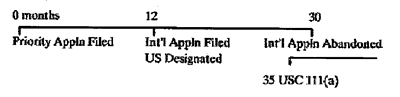
- Rather than submitting national stage application papers under 35 U.S.C. 371, a continuing application (i.e., continuation, C-I-P, or division) under 35 U.S.C. 111(a) of the international (PCT) application may be filed. Pursuant to 35 U.S.C. 365(c), a regular national application filed under 35 U.S.C. 111(a) and 37 CFR 1.53(b) (not under 37 CFR 1.53(d)**) may claim benefit of the filing date of an international application which designates the United States. A typical time line involving a continuing application filed during the pendency of an international application is illustrated as follows:
- If benefit under 35 U.S.C. 119(e), 120 and 365(c) is also being claimed to an earlier filed national application (or international application designating the U.S.) via an intermediate international application designating the U.S., the examiner must examine the intermediate international application to see if it contains a proper reference to the earlier application. The reference will usually be included on the cover page of the published international application and/or may appear in the first sentence>(s)< of the description of the published application. A lack of a proper reference in the published international application does not necessarily mean that a proper reference is not contained in the second international application.
top - Rather than submitting national stage application papers under 35 U.S.C. 371, a continuing application (i.e., continuation, C-I-P, or division) under 35 U.S.C. 111(a) of the international (PCT) application may be filed. Pursuant to 35 U.S.C. 365(c), a regular national application filed under 35 U.S.C. 111(a) and 37 CFR 1.53(b) (not under 37 CFR 1.53(d)**) may claim benefit of the filing date of an international application which designates the United States. A typical time line involving a continuing application filed during the pendency of an international application is illustrated as follows:
PCT / Patent Term
One question asked about a PCT application that was filed in Germany before Nov 29, 2000 (95 or 96) and asked when to measure the US patent term (I hope it was from the date of the PCT application and not when it entered the national stage).
- 2701 Patent Term
- [...]
- INTERNATIONAL APPLICATIONS
- A patent granted on an international application filed on or after June 8, 1995 and which enters the national stage under 35 U.S.C. 371 will have a term which ends twenty years from the filing date of the international application. A continuation or a continuation-in-part application claiming benefit under 35 U.S.C. 365(c) of an international application filed under 35 U.S.C. 363 designating the United States will have a term which ends twenty years from the filing date of the parent international application.
- [...]
- FOREIGN PRIORITY
- Foreign priority under 35 U.S.C. 119(a)-(d), 365(a), or 365(b) is not considered in determining the term of a patent. Accordingly, an application claiming priority under 35 U.S.C. 365(a) or 365(b) has a term which ends twenty years from the filing date of the application in the United States and not the prior international application.
top - Foreign priority under 35 U.S.C. 119(a)-(d), 365(a), or 365(b) is not considered in determining the term of a patent. Accordingly, an application claiming priority under 35 U.S.C. 365(a) or 365(b) has a term which ends twenty years from the filing date of the application in the United States and not the prior international application.
Toy plane with aluminum foil wing:
Applicant claims a toy plane whose wings are covered in aluminum foil. The spec describes a toy plane whose wings are covered in foil but whose body isn't. Reference discloses a plane that is covered entirely in chewing gum wrapper, which includes aluminum foil and another material. Claim is rejected, and applicant responds by arguing that covering only the wings in foil provides useful aerodynamic properties, and therefore the claimed invention is distinguishable from the reference. How should the examiner respond? I said the examiner should maintain the rejection b/c the claim is broad enough to include a plane that is covered entirely in aluminum foil (limitations present in the spec will not be read into the claim if not expressly recited A patent of a paper airplane with aluminum foil (I think) wings. The prior art is a plane covered with aluminum I think. Is it patentable? similar to Oct 2003: PM 46 (airplane with foil on wings, prior art has airplane covered completely in chewing gum wrapper)
(I recently reviewed this answer at the PTO. Yes, the examiner should maintain the rejection in view of practitioner's arguments. The answer description points out that the claim is open-ended ("...comprising wings covered in aluminum foil"). Thus, the prior art anticipates the claim.
top
Information requested from USPTO
Company A gave their agent B, the competitor's patent application number, and asked if the agent B could get the information on the competitor's patent application; whether it has been published and publication date. By telephoning the office, how do you get such information
- 101 General
- [...]When handling an incoming telephone call or an in person request for information regarding an unpublished pending or abandoned patent application, no information should be disclosed until the identity of the requester can be adequately verified as set forth below. Particular care must be exercised when a request is made for the publication date or publication number, or issue date and patent number assigned to a pending patent application. If the publication or issue date is later than the current date (i.e., the date of the request), such information may be given only to the applicant, or the assignee of record, or the attorney or agent of record.
top - [...]When handling an incoming telephone call or an in person request for information regarding an unpublished pending or abandoned patent application, no information should be disclosed until the identity of the requester can be adequately verified as set forth below. Particular care must be exercised when a request is made for the publication date or publication number, or issue date and patent number assigned to a pending patent application. If the publication or issue date is later than the current date (i.e., the date of the request), such information may be given only to the applicant, or the assignee of record, or the attorney or agent of record.
Reissue/Filing Amendment
If you had a Certificate of Correction in the parent, and want to file preliminary amendment in a reissue application, what do you do type of question
- 1411.01 Certificate of Correction or Disclaimer in Original Patent [R-2]
- The applicant should include any changes, additions, or deletions that were made by a Certificate of Correction to the original patent grant in the reissue application without underlining or bracketing. The examiner should * make certain that all Certificate of Correction changes in the patent have been properly incorporated into the reissue application. Certificate of Correction changes and disclaimer of claim(s) under 37 CFR 1.321(a) should be made without using underlining or brackets. Since these are part of the original patent and were made before the reissue was filed, they should show up in the printed reissue >patent< document as part of the original patent, i.e., not in italics or bracketed. If the changes are extensive and/or applicant has submitted them improperly with underlining and brackets, a clean copy of the specification with the Certificate of Correction changes in it may be requested by the examiner.
top - The applicant should include any changes, additions, or deletions that were made by a Certificate of Correction to the original patent grant in the reissue application without underlining or bracketing. The examiner should * make certain that all Certificate of Correction changes in the patent have been properly incorporated into the reissue application. Certificate of Correction changes and disclaimer of claim(s) under 37 CFR 1.321(a) should be made without using underlining or brackets. Since these are part of the original patent and were made before the reissue was filed, they should show up in the printed reissue >patent< document as part of the original patent, i.e., not in italics or bracketed. If the changes are extensive and/or applicant has submitted them improperly with underlining and brackets, a clean copy of the specification with the Certificate of Correction changes in it may be requested by the examiner.
Who to contact question
Asked about who to contact when you are filing petition under CFR 1. 183?
- 1002.01 Procedure
- Petitions, together with the respective application files, are sent to the official having the delegated authority to decide the petition. The petition may be referred to the examiner for a formal statement under 37 CFR 1.181(c) or for an informal memorandum. See MPEP § 711.03(d).
top - Petitions, together with the respective application files, are sent to the official having the delegated authority to decide the petition. The petition may be referred to the examiner for a formal statement under 37 CFR 1.181(c) or for an informal memorandum. See MPEP § 711.03(d).
Missing parts in PCT Application
One questions ask what to do with a PCT app where there were two missing parts of the spec, and the applicant filed them at two intervals. The international filing date will be the date the timely filed filed correction is received by the receiving office. MPEP 1810
Answer: There are only 30 days to do this, and so his 2nd submission was not entered.
top
Velcro Trademark Question
The Velcro trademark question deals with the rules about including trademarked names into an application.
- 7.35.01 Trademark or Trade Name as a Limitation in the Claim
- Claim [1] contains the trademark/trade name [2]. Where a trademark or trade name is used in a claim as a limitation to identify or describe a particular material or product, the claim does not comply with the requirements of 35 U.S.C. 112, second paragraph. See Ex parte Simpson, 218 USPQ 1020 (Bd. App. 1982). The claim scope is uncertain since the trademark or trade name cannot be used properly to identify any particular material or product. A trademark or trade name is used to identify a source of goods, and not the goods themselves. Thus, a trademark or trade name does not identify or describe the goods associated with the trademark or trade name. In the present case, the trademark/trade name is used to identify/describe [3] and, accordingly, the identification/ description is indefinite.
Among the answer choices (from memory): (A) maintain the VELCRO rejection because sufficient structure is not recited (B) maintain the rejection because VELCRO is a recognized prior art fastener, and this fastener would be obvious to replace with the current fastener (C) (don't remember) (D) object to the trademark for being a trademark and request the applicant to modify the specification to include further structure (E) (don't remember)
top
Lip Gloss Question
This question has to do with experimental use and a 102(b) rejection. Know that experimental use doesn't start the 1 year for a 102(b), but using it in a non-experimental way, even in a stupid way, starts the 1 year for 102(b).
It doesn't matter if no one knew or could tell that the use was "public"
top
Spanish Phone Question
A phone was made in Spain. A US application covering the utility of the phone was filed within the appropriate time period. Later, the patent issues for the phone in Spain. Some time later, while the application is still at the USPTO, the inventors realize that they have a great looking phone and they want to get a patent for the design. What can they do? A. File a design app claiming priority to the US application B. File file a CIP of the utility application C. Give up D. File a design application with priority based off the Spanish patent application
Answer: Give up since you only have 6 months for design patents under 35 U.S.C. 172.
Edit to provide more reasoning: This sounds like a 102(d) question. Hard to say without dates, but I'm assuming that the US utility was filed somewhere between 6 and 12 months from the Spanish filing date. if so, once the patent issued in Spain and they hadn't filed in the US within 6 months of the Spanish filing date, the fact that the Spanish patent issued meant they were barred from getting a design patent.
top
Broadening Reissue
When an oath stating non-broadening is filed before two-year date, and then inventors decide to broaden it, right on the two-year anniversary. In one variant, they failed to use a Certificate of Mailing. And then the answers were still obscure (which statute should the examiner invoke, and should he consider it a broadening or non-broadening, when their broadening request came in non-timely?)
- 1412.03 Broadening Reissue Claims
- [...] Where any intent to broaden is indicated in the reissue application within the two years from the patent grant, a broadened claim can subsequently be presented in the reissue after the two year period. >Thus, a broadened claim may be presented in a reissue application after the two years, even though the broadened claim presented after the two years is different than the broadened claim presented within the two years.<
top - [...] Where any intent to broaden is indicated in the reissue application within the two years from the patent grant, a broadened claim can subsequently be presented in the reissue after the two year period. >Thus, a broadened claim may be presented in a reissue application after the two years, even though the broadened claim presented after the two years is different than the broadened claim presented within the two years.<
Claims stand or fall together in appeal
One question reported about the applicant asserting the claims do not rise or fail together, and the Examiner's Answer stating that they do. Question was, what will the Board do as to the rejected claims?
- 1206 Appeal Brief
- [...] In the absence of a separate statement that the claims do not stand or fall together, the Board panel assigned to the case will normally select the broadest claim in a group and will consider only that claim, even though the group may contain two broad claims, such as “ABCDE” and “ABCDF.” The same would be true in a case where there are both broad method and apparatus claims on appeal in the same group. The rationale behind the rule, as amended, is to make the appeal process as efficient as possible. Thus, while the Board will consider each separately argued claim, the work of the Board can be done in a more efficient manner by selecting a single claim from a group of claims when the appellant does not meet the requirements of 37 CFR 1.192(c)(7).
- It should be noted that 37 CFR 1.192(c)(7) requires the appellant to perform two affirmative acts in his or her brief in order to have the separate patentability of a plurality of claims subject to the same rejection considered. The appellant must (A) state that the claims do not stand or fall together and (B) present arguments why the claims subject to the same rejection are separately patentable. Where the appellant does neither, the claims will be treated as standing or falling together. Where, however, the appellant (A) omits the statement required by 37 CFR 1.192(c)(7) yet presents arguments in the argument section of the brief, or (B) includes the statement required by 37 CFR 1.192(c)(7) to the effect that one or more claims do not stand or fall together (i.e., that they are separately patentable) yet does not offer argument in support thereof in the “Argument” section of the brief, the appellant should be notified of the noncompliance as per 37 CFR 1.192(d). Ex parte Schier, 21 USPQ2d 1016 (Bd. Pat. App. & Int. 1991); Ex parte Ohsumi, 21 USPQ2d 1020 (Bd. Pat. App. & Int. 1991).
8TH ED, REVISION 4 No longer has 37 CFR 1.192. Changes made: "removed and reserved, 69 FR 49959, Aug. 12, 2004, effective Sept. 13, 2004" It only says [Reserved] now.
top
RCE during Appeal
One question asks about how the applicant can withdraw his appeal, once the Examiner's Answer was filed, and have some new prior art considered and you had to choose between filing an RCE and filing a Continuation.
- 1215.01 Withdrawal of Appeal
- Prior to a decision by the Board, if an applicant wishes to withdraw an application from appeal and to reopen the prosecution of the application, applicant can file a request for continued examination (RCE) under 37 CFR 1.114, accompanied by a submission (i.e., a reply responsive within the meaning of 37 CFR 1.111 to the last outstanding Office action) and the RCE fee set forth under 37 CFR 1.17(e). Note that the RCE practice under 37 CFR 1.114 does not apply to utility or plant patent applications filed before June 8, 1995, design applications, or reexamination proceedings.
- To avoid the rendering of decisions by the Board in applications which have already been refiled as continuations, applicants should promptly inform the clerk of the Board in writing as soon as they have positively decided to refile or to abandon an application containing an appeal awaiting a decision. Applicants also should advise the Board when an RCE is filed in an application containing an appeal awaiting decision. Failure to exercise appropriate diligence in this matter may result in the Board refusing an otherwise proper request to vacate its decision.
6/17/07 edit: I haven't seen this question, so this is just speculation, but I wonder if the question is getting you to look at timing. If you are more than six months out after the final Ofice action issued, once the Notice of Appeal is withdrawn the application is abandoned (unless file cont/RCE on the same day). I don't see any reason why you can't file a regular continuation instead of an RCE on or before the day Notice of Appeal is withdrawn.
top
Federal Court Decisions binding for Office
One was about the extent to which a Federal Court decision was binding on the Office: if the Court finds it not invalid, or if the Court finds it invalid, etc.
- 2286 Ex Parte Reexamination and Litigation Proceedings
- The issuance of a final Federal Court decision upholding validity during an ex parte reexamination also will have no binding effect on the examination of the reexamination. [...] The Office is not bound by a court's holding of patent validity and should continue the reexamination. The court notes that district courts and the Office use different standards of proof in determining invalidity, and thus, on the same evidence, could quite correctly come to different conclusions. Specifically, invalidity in a district court must be shown by “clear and convincing” evidence, whereas in the Office, it is sufficient to show nonpatentability by a “preponderance of evidence.” Since the “clear and convincing” standard is harder to satisfy than the “preponderance” standard, deference will ordinarily be accorded to the factual findings of the court where the evidence before the Office and the court is the same. If sufficient reasons are present, claims held valid by the court may be rejected in reexamination.
- On the other hand, a final Federal Court holding of invalidity or unenforceability (after all appeals), is binding on the Office. Upon the issuance of a final holding of invalidity or unenforceability, the claims held invalid or unenforceable will be withdrawn from consideration in the reexamination. The reexamination will continue as to any remaining claims.
top
Appeal: New ground of rejection
Question related to the Board having remanded to the Examiner with a new ground of rejection, and the applicant wanted to reinstate his appeal – did he need to file a new Appeal Brief or could he proceed without one?
- 1214.01 Procedure Following New Ground of Rejection by Board
- When the Board makes a new rejection under 37 CFR 1.196(b), the appellant, as to each claim so rejected, has the option of: (A) submitting an appropriate amendment and/or a showing of facts (37 CFR 1.196(b)(1)); or (B) requesting rehearing (37 CFR 1.196(b)(2)).
top - When the Board makes a new rejection under 37 CFR 1.196(b), the appellant, as to each claim so rejected, has the option of: (A) submitting an appropriate amendment and/or a showing of facts (37 CFR 1.196(b)(1)); or (B) requesting rehearing (37 CFR 1.196(b)(2)).
Restriction Requirement / Continuation Application
One had to do with a Continuation of an application where a restriction requirement had been made, and the applicant had ignored the requirement and filed with all the original claims.
- 804.01 Prohibition of Double Patenting Rejections Under 35 U.S.C. 121
- [...]Note that a restriction requirement in an earlier-filed application does not carry over to claims of a continuation application in which the examiner does not reinstate or refer to the restriction requirement in the parent application. Reliance on a patent issued from such a continuation application to reject claims in a later-filed divisional application is not prohibited under 35 U.S.C. 121.
top - [...]Note that a restriction requirement in an earlier-filed application does not carry over to claims of a continuation application in which the examiner does not reinstate or refer to the restriction requirement in the parent application. Reliance on a patent issued from such a continuation application to reject claims in a later-filed divisional application is not prohibited under 35 U.S.C. 121.
Small Entity Status
Questions about small entity status include who can sign the assertion of it. One about if the small entity status changes before issuance.
- 509.03 Claiming Small Entity Status
- (2) Parties who can sign and file the written assertion. The written assertion can be signed by:
- (i) One of the parties identified in § 1.33(b) (e.g., an attorney or agent registered with the Office), § 3.73(b) of this chapter notwithstanding, who can also file the written assertion;
- (ii) At least one of the individuals identified as an inventor (even though a § 1.63 executed oath or declaration has not been submitted), notwithstanding § 1.33(b)(4), who can also file the written assertion pursuant to the exception under § 1.33(b) of this part; or
- (iii) An assignee of an undivided part interest, notwithstanding §§ 1.33(b)(3) and 3.73(b) of this chapter, but the partial assignee cannot file the assertion without resort to a party identified under § 1.33(b) of this part.
- [...]
- (g)(1) New determination of entitlement to small entity status is needed when issue and maintenance fees are due. Once status as a small entity has been established in an application or patent, fees as a small entity may thereafter be paid in that application or patent without regard to a change in status until the issue fee is due or any maintenance fee is due.
top - (2) Parties who can sign and file the written assertion. The written assertion can be signed by:
Documents an Assignee Not of Record can sign
One question was, what things can an assignee sign, if he has never properly recorded his ownership? Not sure if what the other options were, but it may be worth taking a look at 37 CFR 3.71 and 3.73...
- 37 CFR 3.71. Prosecution by assignee.
- (a) Patents — conducting of prosecution. One or more assignees as defined in paragraph (b) of this section may, after becoming of record pursuant to paragraph (c) of this section, conduct prosecution of a national patent application or a reexamination proceeding to the exclusion of either the inventive entity, or the assignee(s) previously entitled to conduct prosecution.
- (b) Patents — assignee(s) who can prosecute. The assignee(s) who may conduct either the prosecution of a national application for patent or a reexamination proceeding are:
- (1) A single assignee. An assignee of the entire right, title and interest in the application or patent being reexamined who is of record, or
- (2) Partial assignee(s) together or with inventor(s). All partial assignees, or all partial assignees and inventors who have not assigned their right, title and interest in the application or patent being reexamined, who together own the entire right, title and interest in the application or patent being reexamined. A partial assignee is any assignee of record having less than the entire right, title and interest in the application or patent being reexamined.
- (c) Patents — Becoming of record. An assignee becomes of record either in a national patent application or a reexamination proceeding by filing a statement in compliance with § 3.73(b) that is signed by a party who is authorized to act on behalf of the assignee.
- (a) Patents — conducting of prosecution. One or more assignees as defined in paragraph (b) of this section may, after becoming of record pursuant to paragraph (c) of this section, conduct prosecution of a national patent application or a reexamination proceeding to the exclusion of either the inventive entity, or the assignee(s) previously entitled to conduct prosecution.
6/4/2007 -- (not sure -- but this may be helpful to answer the question).
MPEP 324 VII. WHEN OWNERSHIP NEED NOT BE ESTABLISHED
Examples of situations where ownership need not be established under 37 CFR 3.73(b) are when the assignee: signs a request for a continued prosecution application under 37 CFR 1.53(d), where papers establishing ownership under 37 CFR 3.73(b) were filed in the prior application and ownership has not changed ( MPEP § 201.06(d)); signs a small entity statement ( MPEP § 509.03); signs a statement of common ownership of two inventions ( MPEP § 706.02(l)(2)); signs a NASA or DOE property rights statement ( MPEP § 151); signs an affidavit under 37 CFR 1.131 where the inventor is unavailable ( MPEP § 715.04); signs a certificate under 37 CFR 1.8 ( MPEP § 512); or files a request for reexamination of a patent under 37 CFR 1.510 ( MPEP § 2210).
top
Means language claim question
Question referring to 35 U.S.C. 112 paragraph 6. May be a repeat question about a claim with a door having a doorknob and something else, using “means” language, and the cited prior art discloses a handle, and how do you overcome the reference? Correct choice likely reciting a negative limitation: “no handle”.
- 35 U.S.C. 112, paragraph 6:
- An element in a claim for a combination may be expressed as a means or step for performing a specified function without the recital of structure, material, or acts in support thereof, and such claim shall be construed to cover the corresponding structure, material, or acts described in the specification and equivalents thereof.
- 2173.05(i) Negative Limitations
- The current view of the courts is that there is nothing inherently ambiguous or uncertain about a negative limitation. So long as the boundaries of the patent protection sought are set forth definitely, albeit negatively, the claim complies with the requirements of 35 U.S.C. 112, second paragraph. [...]
6/3/07- Actually, this is Oct '03 AM Q#24 Negative limitation is usually OK, but here is "new matter" so negative limitation is wrong answer here. Correct answer is (D) An amendment to the claim substituting for the term "means for pulling the door open" the structure of a handle and a knob.
From the Answers Explanation: The examiner has made a prima facie case of equivalent in the Office action to support the rejection based on 35 U.S.C. § 102. By amending the claim to no longer include the means limitation in question, the claim becomes narrower inasmuch as it no longer includes equivalents under 35 U.S.C. § 112, paragraph 6 for examination purposes. Thus, (D) overcomes the lack of novelty rejection under these circumstances.
top
102(a): Need to file foreign language translation
One question asks whether you have to file an English translation of a foreign-language reference.
- § 1.98 Content of information disclosure statement.
- [...]
- (3)(i) A concise explanation of the relevance, as it is presently understood by the individual designated in § 1.56(c) most knowledgeable about the content of the information, of each patent, publication, or other information listed that is not in the English language. The concise explanation may be either separate from applicant's specification or incorporated therein.
- (ii) A copy of the translation if a written English-language translation of a non-English-language document, or portion thereof, is within the possession, custody, or control of, or is readily available to any individual designated in § 1.56(c).
top
- [...]
Death of inventor before application is filed
Death of inventor BEFORE application filed - many facts indicated that inventor had possession of invention prior to death - legal rep. can file application. Fact pattern looked something like A invented a fishing device but passed away before application is filed. The heir is 13 years old and legally incapacitated. Barbara is the attorney in living will - and seem to be the most likely correct answer.
- 37 CFR 1.42. When the inventor is dead.
- In case of the death of the inventor, the legal representative (executor, administrator, etc.) of the deceased inventor may make the necessary oath or declaration, and apply for and obtain the patent. Where the inventor dies during the time intervening between the filing of the application and the granting of a patent thereon, the letters patent may be issued to the legal representative upon proper intervention.
-Question fact pattern is some thing like this: Inventor dead, appointed best fried as executor/administrator of will. Son thinks that he will be 1 of the heirs of the estate. Wants to go ahead and file for patent application using Dad's invention. The estate is over the minimum sum required by state law for the appointment of administrator. -Answer can be found in section 409.01 (Death of Inventor), subsection - A, 37CFR 1.42. Executor/legal representative has to be the one to file application (sign oath etc)in this case. Heirs can file only if no will, or no executor appointed in will and estate was under the sum required by the state for appointing an executor.
8/10/2007 Variation on the death of Inventor: Death of inventor AFTER application is filed, and AFTER assignment of all rights, BEFORE allowance
409.01(e) If Applicant of Assigned Application Dies
When an applicant who has prosecuted an application after assignment, dies, the administrator of the deceased applicant's estate may carry on the prosecution upon filing letters of administration unless and until the assignee intervenes (MPEP § 402.07).
top
Correcting PCT application / No address
Obscure facts, like how long you have to correct a PCT application with no address after you are invited to correct the problem. Answer: I did a search on the USPTO website. The site states the following: The receiving Office shall promptly mail the invitation to the applicant and shall fix a time limit, reasonable under the circumstances of the case, for filing the correction. The time limit shall not be less than 10 days, and shall not exceed one month, from the date of the invitation. If such time limit expires after the expiration of one year from the filing date of any application whose priority is claimed, the receiving Office may call this circumstance to the attention of the applicant.
Edit 8/22: You can find this information in PCT Rule 20.6 (under the Patent Cooperation Treaty section at the end of the MPEP):
20.6 Invitation to Correct ... (b) The receiving Office shall promptly mail the invitation to the applicant and shall fix a time limit, reasonable under the circumstances of the case, for filing the correction. The time limit shall not be less than 10 days, and shall not exceed one month, from the date of the invitation. If such time limit expires after the expiration of one year from the filing date of any application whose priority is claimed, the receiving Office may call this circumstance to the attention of the applicant.
-- This rule is also referenced in MPEP 1810 under the heading: THE "INTERNATIONAL FILING DATE". The International Application (PCT) filing date accorded the application is the date of compliance with the invitation to correct. It should be noted that, based on my reading of this section, an applicant can apparently lose his/her rights to priority if the deficiency in the IA is not cleared up within 12 months from the date of priority, if any, claimed in the International Application--EVEN IF the time to respond to the invitation to correct has not expired.
top
PCT-going right to national stage
One PCT question asked about what is required if you don't make a demand and want to proceed straight to the national stage and gave 5 very distinct fact patterns with how to accomplish it and what needs to be filed. One of the answers I narrowed it down to added on top of what seemed to be the right answer, whether you had to pay a surcharge because there was no international search done. I think I picked that one because the other answers looked worse to me, and I didn't have time to look up all of the various nuances addressed by the question.
6/4/2007 I don't know anything about the question, but paying a surcharge because you went national before the ISR issued sounds fishy to me. You pay the initial search fee when you file the PCT (you select the ISA at that time too, either EP, US or now Korea too). Though this can be refunded if you withdraw the application before it is searched. The USPTO will do their own search (which you pay for as part of the national filing fee) anyway . . .
7/30/07 See MPEP 1893.01: "Thus, in the absence of an express request for early processing of an international application under 35 U.S.C. 371(f) and compliance with the conditions provided therein, the U.S. national stage will commence upon expiration of 30 months from the priority date of the international application. Pursuant to 35 U.S.C. 371(f), the national stage may commence earlier than 30 months from the priority date, provided applicant makes an express request for early processing and has complied with the applicable requirements under 35 U.S.C. 371(c)."
It is not clear from the facts here, but MPEP 1843.02 "Certain Subject Matter Need Not Be Searched" may be relevant.
top
Appeal: New grounds for rejection by the Board
The fact pattern looks like: (1) two claims 1 and 2 rejected and appealed to the board. (2) board affirms rejection on 1. (3) board overturns rejection on 2. (4) board enters new rejection on 2. (5) applicant chooses to reopen prosecution on 2. (6) claim 2 rejected again.
=> so what should applicant do ? file new appeal on 2 ? file new appeal on 2 and get judicial review on rejection 1 at the same time ?
Edit to add: I think you cannot get the Board to consider claim 1 at this time (should have requested a rehearing when the original affirmance was made) [Edit 7/31/07: no need to make an immediate request for reconsideration: MPEP 1214.01 "...If the appellant elects to proceed before the examiner with regard to the new rejection, the Board's affirmance of the examiner's rejection will be treated as nonfinal for purposes of seeking judicial review, and no request for reconsideration of the affirmance need be filed at that time."]. You can file a new appeal on claim 2 though -- see 1214.01.
MPEP 1214.01:
- The new ground of rejection raised by the Board does not reopen prosecution except as to that subject matter to which the new rejection was applied. If the Board's decision in which the rejection under 37 CFR 41.50(b) was made includes an affirmance of the examiner's rejection, the basis of the affirmed rejection is not open to further prosecution. If the appellant elects to proceed before the examiner with regard to the new rejection, the Board's affirmance of the examiner's rejection will be treated as nonfinal for purposes of seeking judicial review, and no request for reconsideration of the affirmance need be filed at that time. Prosecution before the examiner of the 37 CFR 41.50(b) rejection can incidentally result in overcoming the affirmed rejection even though the affirmed rejection is not open to further prosecution. Therefore, it is possible for the application to be allowed as a result of the limited prosecution before the examiner of the 37 CFR 41.50(b) rejection. If the application becomes allowed, the application should not be returned to the Board. Likewise, if the application is abandoned for any reason, the application should not be returned to the Board. If the rejection under 37 CFR 41.50(b) is not overcome, the applicant can file a second appeal (as discussed below). Such appeal must be limited to the 37 CFR 41.50(b) rejection and may not include the affirmed rejection. If the application does not become allowed or abandoned as discussed above, once prosecution of the claims which were rejected under 37 CFR 41.50(b) is terminated before the examiner, the application file must be returned to the Board so that a decision making the original affirmance final can be entered.
top
Canadian Patent Agent in the USA
Canadian patent agent living in America question?
- MPEP 402
- A power of attorney or authorization given to a registered Canadian patent agent, to be valid, must be given by the applicants, all of whom are located in Canada. See 37 CFR 10.6(c).
- 37 CFR 10.6
- (c) Foreigners. Any foreigner not a resident of the United States who shall file proof to the satisfaction of the Director that he or she is registered and in good standing before the patent office of the country in which he or she resides and practices and who is possessed of the qualifications stated in § 10.7, may be registered as a patent agent to practice before the Office for the limited purpose of presenting and prosecuting patent applications of applicants located in such country, provided: The patent office of such country allows substantially reciprocal privileges to those admitted to practice before the United States Patent and Trademark Office. Registration as a patent agent under this paragraph shall continue only during the period that the conditions specified in this paragraph obtain. . .
- . . .Upon ceasing to reside in such country, the patent agent registered under this section is no longer qualified to be registered under this section, and the OED Director shall promptly remove the name of the patent agent from the register and publish the fact of removal.
top
IDS / Not exact wording
Practitioner submitted a Information Disclosure Statement within three months after receiving communication from a foreign patent office. Application has already been allowed, but issue fee hasn't been paid yet. In the required 37 CFR 1.97(e) statement the wording doesn't explicitly mention that the information from the foreign patent office was the first such citation from a foreign patent office in a counterpart application.
Somewhere deep inside MPEP609 I found this, which made me believe the submission will still be accepted and processed.
- If an information disclosure statement includes a copy of a dated communication from a foreign patent office which clearly shows that the statement is being submitted within 3 months of the date on the communication, the copy will be accepted as the required *>statement under 37 CFR 1.97(e)(1)<. It will be assumed, in the absence of evidence to the contrary, that the communication was for a counterpart foreign application.
Edit 8/22: Not entirely sure of the fact pattern here, but it may be similar/identical to April2002AM #2, IF it has something to do with maximizing Patent Term Adjustment/Extension (can't remember which).
The gist of the question is that, since you're after a notice of allowance, merely filing the IDS with appropriate fee and statement within 30 days of the applicant's receipt of allowance may deduct from the accumulated PTA (filing an IDS after allowance is a delaying action that reduces PTA). However, filing within 30 days of a foreign office's sending of a notification does not trigger the PTA reduction. This plays out in the following fact pattern similar to the April2002 question:
If the foreign office notification was dated, say, Sept. 10, and the allowance was dated Sept. 20, AND the applicant became aware of the foreign office notification for the first time on Sept. 25, you would technically have until Oct. 25 to submit the IDS (30 days from the applicant's receipt of the information). However, if you choose to file no later than Oct. 10 (30 days from the sending), you inherently meet the 30-days-after-receipt requirement, AND lose no accumulated PTA time.
top
How to claim benefit
Question about where in an application you claim benefit of an earlier application. I believe answer options were combinations of a) in the first sentence of the specification, b) in the application data sheet and c) in the oath or declaration.
- MPEP 201.11
- An application in which the benefits of an earlier application are desired must contain a specific reference to the prior application(s) in the first sentence of the specification or in an application data sheet (37 CFR 1.78(a)(2) and (a)(5)).
top - An application in which the benefits of an earlier application are desired must contain a specific reference to the prior application(s) in the first sentence of the specification or in an application data sheet (37 CFR 1.78(a)(2) and (a)(5)).
Basic filing fee
One question deals with the basic filing fee. Among the answer options is that the basic filing fee includes up to three independent claims and 20 claims altogether.
top
Correcting Errors in PCT Application
Applicant submits three different amendments to the UPSTO as the Receiving Office of a PCT application. a) Correcting a misspelled word "ccar" b) Adding a drawing that was accidentally left out but is in earlier filed provisional or non-provisional application benefit of which is claimed. c) Adding a page to explain in the specification something clearly shown on a drawing. Question is what will the USPTO do?
I believe the question targeted MPEP 1836 - rectification of obvious errors, in which you can read.
- Obvious errors in the international application or other papers submitted by the applicant may generally be rectified under PCT Rule 91, if the rectification is authorized, as required, within the applicable time limit. [...] The omission of entire sheets of the description cannot be rectified, even if resulting from inattention at the stage of copying or assembling sheets. Applicants often attempt to rely upon the priority application to establish a basis for obvious error. The priority document (application) cannot be used to support obvious error corrections. The rectification is obvious only in the sense that anyone would immediately realize that nothing else could have been intended than what is offered as rectification.
- Examples of obvious errors that are rectifiable include linguistic errors, spelling errors and grammatical errors so long as the meaning of the disclosure does not change upon entry of the rectification. Changes to chemical or mathematical formulas would not generally be rectifiable unless they would be common knowledge to anyone.< A missing chemical formula or missing line of text would not be considered >to be an< obvious error subject to rectification. **
top
Small Entity's Filing Fee - Refund
Applicant accidentally paid large entity filing fee even though entitled to small entity status. Can he get a refund and how long does he have to apply?
- 37 CFR 1.28(a). Refunds when small entity status is later established; how errors in small entity status are excused..
- (a) Refunds based on later establishment of small entity status.
- A refund pursuant to § 1.26, based on establishment of small entity status, of a portion of fees timely paid in full prior to establishing status as a small entity may only be obtained if an assertion under § 1.27(c) and a request for a refund of the excess amount are filed within three months of the date of the timely payment of the full fee. The three-month time period is not extendable under § 1.136. Status as a small entity is waived for any fee by the failure to establish the status prior to paying, at the time of paying, or within three months of the date of payment of, the full fee.
top - (a) Refunds based on later establishment of small entity status.
Multiplicity
Multiplicity question - applicant has one utility claim and more than 900 claims covering small ornamental differences. Answer is that the examiner should call the applicant and have him select a few claims for examination.
- M.P.E.P. Section 2173.05, Specific Topics Related to Issues Under 35 U.S.C.
- If a rejection on multiplicity is in order the examiner should make a telephone call explaining that the claims are unduly multiplied and will be rejected on that ground. Note MPEP Section 408. The examiner should request selection of a specified number of claims for purposes of examination.
top - If a rejection on multiplicity is in order the examiner should make a telephone call explaining that the claims are unduly multiplied and will be rejected on that ground. Note MPEP Section 408. The examiner should request selection of a specified number of claims for purposes of examination.
Rejection after Allowance
Examiner finds a new prior art reference based on which the claim should be rejected - but the notice of allowance has already been sent. Now what?
- 1308.01 Rejection After Allowance [R-2]
- A claim noted as allowable shall thereafter be rejected only with the approval of the primary examiner. Great care should be exercised in authorizing such rejection. See MPEP § 706.04.
- When a new reference is discovered, which obviously is applicable to one or more of the allowed claims in an application in issue, a * >memorandum< is addressed to the Technology Center (TC) Director, requesting that the application be withdrawn from issue for the purpose of applying the new reference. This *>memorandum< should cite the reference, and, if need be, briefly state its application. The *>memorandum< should be submitted with the reference and the file wrapper>, if the application file is in paper<.
top - A claim noted as allowable shall thereafter be rejected only with the approval of the primary examiner. Great care should be exercised in authorizing such rejection. See MPEP § 706.04.
103(c) / Effective Date Nov. 29, 1999
One question requires you to know that 35 U.S.C. 103(c) prior art exclusion only applies to applications filed after November 29, 1999.
- 706.02(l)(1) Rejections Under 35 U.S.C. 102(e)/103; 35 U.S.C. 103(c)
- Effective November 29, 1999, subject matter which was prior art under former 35 U.S.C. 103 via 35 U.S.C. 102(e) is now disqualified as prior art against the claimed invention if that subject matter and the claimed invention “were, at the time the invention was made, owned by the same person or subject to an obligation of assignment to the same person.” This change to 35 U.S.C. 103(c) applies to all utility, design and plant patent applications filed on or after November 29, 1999, including continuing applications filed under 37 CFR 1.53(b), continued prosecution application filed under 37 CFR 1.53(d), and reissues. The amendment to 35 U.S.C. 103(c) does not affect any application filed before November 29, 1999, a request for examination under 37 CFR 1.129 of such an application, nor a request for continued examination under 37 CFR 1.114 of such an application.
top - Effective November 29, 1999, subject matter which was prior art under former 35 U.S.C. 103 via 35 U.S.C. 102(e) is now disqualified as prior art against the claimed invention if that subject matter and the claimed invention “were, at the time the invention was made, owned by the same person or subject to an obligation of assignment to the same person.” This change to 35 U.S.C. 103(c) applies to all utility, design and plant patent applications filed on or after November 29, 1999, including continuing applications filed under 37 CFR 1.53(b), continued prosecution application filed under 37 CFR 1.53(d), and reissues. The amendment to 35 U.S.C. 103(c) does not affect any application filed before November 29, 1999, a request for examination under 37 CFR 1.129 of such an application, nor a request for continued examination under 37 CFR 1.114 of such an application.
Maintenance Fee Paid / Check Returned
One question deals with a maintenance fee that was paid, but the patent was not identified correctly with the payment, so the USPTO mailed the check back. Answer options refer to 37 CFR 1.377. Review of decision refusing to accept and record payment of a maintenance fee filed prior to expiration of patent and 37 CFR 1.378. Acceptance of delayed payment of maintenance fee in expired patent to reinstate patent.
I chose the answer option based on 37 CFR 1.5. Identification of patent, patent application, or patent-related proceeding that covers mail returned by the USPTO for not identifying an application (not sure if correct) [Edit: see MPEP 2580].
- Any correspondence not containing such identification will be returned to the sender where a return address is available. The returned correspondence will be accompanied with a cover letter which will indicate to the sender that if the returned correspondence is resubmitted to the Patent and Trademark Office within two weeks of the mail date on the cover letter, the original date of receipt of the correspondence will be considered by the Patent and Trademark Office as the date of receipt of the correspondence.
§ 1.377 Review of decision refusing to accept and record payment of a maintenance fee filed prior to expiration of patent. (a) Any patentee who is dissatisfied with the refusal of the Patent and Trademark Office to accept and record a maintenance fee which was filed prior to the expiration of the patent may petition the Director to accept and record the maintenance fee. (b) Any petition under this section must be filed within two months of the action complained of, or within such other time as may be set in the action complained of, and must be accompanied by the fee set forth in § 1.17(g). The petition may include a request that the petition fee be refunded if the refusal to accept and record the maintenance fee is determined to result from an error by the Patent and Trademark Office. (c) Any petition filed under this section must comply with the requirements of § 1.181(b) and must be signed by an attorney or agent registered to practice before the Patent and Trademark Office, or by the patentee, the assignee, or other party in interest.
MPEP 2580: "This petition [under §1.377] may be used, for example, in situations where an error is present in the identifying data required by 37 CFR 1.366(c) with the maintenance fee payment, i.e., either the patent number or the application number * >is< incorrect." However, "A petition under 37 CFR 1.377 would not be appropriate where the patentee paid a maintenance fee on one patent when the patentee intended to pay the maintenance fee on a different patent but through error identified the wrong patent number and application number."
top
Indefinite Claim using 'high'
This question asked if a claim was indefinite because it used the word 'high' instead of a range. There were various answers ranging from never to always. I chose one in the middle which said something about it being acceptable as long as there is enough description in the specification that would allow one of ordinary skill in the art to know what 'high' means. See Atmel Corp. v. Information Storage Devices, Inc. in MPEP 2181.
top
What can an assignee do before taking ownership
I believe there may be several forms of this question out there. I believe the answer for mine was sign a small entity statement. The situations are listed in MPEP 324 part VII.
top
Anticipation
Invention has 2 layers x + z "congruous all the way" in between the layers. Prior art has 2 layers x + z + "blah blah blah" in between the layers.
Question is which claim is anticipated. One answer choice: Claim says "comprising x and z". Other choices include other stuff, not just x and z. Answer should be this claim mentioned because it's broad enough to read on Prior Art.
One variant of this question appears as Q17 April 2000 AM. Note that in this question, two options are correct. Answer where layers x + z are congruent and an answer where x + z where there is a negative limitation specifically excluding the "bla bla bla".
top
Claim of priority to Japanase national app to overcome prior art
Applicant filed Japanese app. Then file PCT app, correctly claiming priority. Then file USA national stage app. But there is prior art against USA app. The prior art may be overcome if applicant can make a claim of priority to the Japanese National app. Can the claim of priority be made? I said Yes, so long as verified copy of Japanese National App is filed. Theere may have been a 16-month requirement too, for claim of priority from the National(?) or PCT (?) app. Or was that a different question? Sorry, there were 3 to 4 different Japanese app questions. There definitely was a question that wanted to know about the 16-month (or was it 17?) requirement for PCT apps, for correcting ..something..
7/18/07 -- Sounds like MPEP1828, Priority Claim and Document, may be relevant.
Effective July 1, 1998, applicant may correct or add a priority claim by a notice submitted to the Receiving Office or the International Bureau within 16 months from the priority date, or where the priority date is changed, within 16 months from the priority date so changed, whichever period expires first, provided that a notice correcting or adding a priority claim may in any event be submitted until the expiration of 4 months from the international filing date.
top
Number of Rejections Required for Appeal purposes when count from parent to continuation
Have X # of claims. All rejected. File continuation with same X claims. rejected in continuation. Can you appeal to board? Answer choices: Yes, b/c there has been ONE rejection. Yes, b/c there has been TWO rejections. Other 3 choices are "not appealable". Correct Anwswer? Look it up.
MPEP 1204 The limitation of "twice rejected" does not have to be related to a particular application.... For example, if any claim was rejected in a parent application, and the claim is again rejected in a continuing application, then applicant can choose to file an appeal in the continuing application, even if the claim was rejected only once in the continuing application. >Applicant cannot file an appeal in a continuing application, or after filing a request for continued examination (RCE) under 37 CFR 1.114, until the application is under a rejection.
top
Divisional Reissue
A patent containing claims 1-10 has issued. The subject matter of claims 1-5 was invented by inventor A, who has assigned his rights to your client, company C. The subject matter of claims 6-10 was invented by inventor B, who refuses to cooperate with company C unless he is the sole named inventor of his own patent. Company C wishes to divide the claims such that one patent contains only claims 1-5 and has inventor A as the sole inventor, and another patent contains claims 6-10 and has inventor B as the sole inventor. How should you advise your client?
a) this is impossible
b) use a certificate of correction to cancel claims 6-10 and remove inventor B from the patent, and file a divisional application on claims 6-10 listing B as the inventor
c) file a reissue, cancel claims 6-10, and remove B as an inventor
d) file a reissue of the original application along with a divisional reissue, cancel claims 1-5 and remove inventor A from the first reissue, move claims 6-10 and inventor B to the divisional reissue
e) file two simultaneous reissue applications from the same patent, cancel claims 1-5 and remove inventor A from the first reissue, cancel claims 6-10 and remove inventor B from the second reissue.
This is a tough one, but, based on the description above I think the likely answer is E and not D. D sounds more like what would happen if the Examiner restricted out claims that you added when you filed the reissue, and you wanted to pursue them. Even so, I'm not sure how you "move" claims to the divisional reissue. E sounds more straightforward.
MPEP 1451
37 CFR 1.176(b) permits the examiner to require restriction in a reissue application between the original claims of the patent and any newly added claims which are directed to a separate and distinct invention(s). See also MPEP § 1450. As a result of such a restriction requirement, divisional applications may be filed for each of the inventions identified in the restriction requirement.
Applicant may initiate a division of the claims by filing more than one reissue application in accordance with 37 CFR 1.177. The multiple reissue applications which are filed may contain different groups of claims from among the original patent claims, or some of the reissue applications may contain newly added groups (not present in the original patent).
top
Hairgel Question
I have not seen this question myself -- but I'm trying to patch something together from comments of others:
"One where a hairdresser find his competitor gets a patent but has an advertisement that he was selling the patented product one year before the competitor got his patent to that product."
"Hairgel question, someone gets a patent application in 99 and it issues as a patent in 01. A couple years later, a competitor realizes that it is the exact same hairgel he had advertised in 98. The question asks what can he do to correct it, petition for a correction, ex parte reexam, inter parte reexam, reissue or certificate of correction."
My thoughts: Reissue and certificates of correction have to be requested by the inventors or the assignee (consent of inventors needed for broadening reissue). A competitor can request rexam (either inter partes or ex parte) only if there is a patent or printed publication raising a substantial new question of patentablility. Thus, unless the advertisment constitutes a printed publication (with sufficient disclosure to raise substantial new question of patenability), the competitor is SOL. If the advert qualified, then ex parte reexam would be available to the competitor, based on facts above. Inter partes reexam would be available only if the application was filed on or after Nov 29, 1999 (MPEP 2609). It would probably be ex parte since it happened 98/99 and there was a printed ad.
(edited Jul 16, 2007) This sounds just like the Einstein/Weisman football pads question from April 2002 PM #37 where the ex parte reexamination option was correct. (edit -- yes, it is very similar. The hairgel question is a bit tougher though, in that it does not spell out (to my recollection), like Q37, that the advertisements raise a substantial question of patentability.)
top
Means plus function, determining equivalence
8/10/2007 Question asking how to determine equivalence in a means-plus-function situation. Posed in the form: which of the following are in accord with MPEP. I found MPEP 2183 to have the answers verbatim.
2183 MAKING A PRIMA FACIE CASE OF EQUIVALENCE If the examiner finds that a prior art element (A) performs the function specified in the claim, (B) is not excluded by any explicit definition provided in the specification for an equivalent, and (C) is an equivalent of the means- (or step-) plus-function limitation, the examiner should provide an explanation and rationale in the Office action as to why the prior art element is an equivalent. Factors that will support a conclusion that the prior art element is an equivalent are: (A) the prior art element performs the identical function specified in the claim in substantially the same way, and produces substantially the same results as the corresponding element disclosed in the specification. ... (B) a person of ordinary skill in the art would have recognized the interchangeability of the element shown in the prior art for the corresponding element disclosed in the specification... (C) there are insubstantial differences between the prior art element and the corresponding element disclosed in the specification... (D) the prior art element is a structural equivalent of the corresponding element disclosed in the specification...
top
Investigating deceptive intent
8/10/2007 I had a question asking about what situation does the PTO still investigate violotations of 37 CFR 1.56. I think the answer is in MPEP 1448
1448 FRAUD, INEQUITABLE CONDUCT, OR DUTY OF DISCLOSURE ISSUES
The Office no longer investigates and rejects reissue applications under 37 CFR 1.56. The Office will not comment upon duty of disclosure issues which are brought to the attention of the Office in reissue applications except to note in the application, in appropriate circumstances, that such issues are no longer considered by the Office during its examination of patent applications.
...Form paragraph 14.21.09 should be used where the examiner becomes aware of a judicial determination of fraud, inequitable conduct or violation of the duty of disclosure on the part of the applicant independently of the record of the case, i.e., the examiner has external knowledge of the judicial determination. Form paragraph 14.22 should be used where, in the application record, there is (a) an explicit, unequivocal admission by applicant of fraud, inequitable conduct or violation of the duty of disclosure which is not subject to other interpretation, or (b) information as to a judicial determination of fraud, inequitable conduct or violation of the duty of disclosure on the part of the applicant. External information which the examiner believes to be an admission by applicant should never be used by the examiner, and such external information should never be made of record in the reissue application.
top
2 month rule for final office action
I had a question that asked about extension fees when the Applicant has replied to a final Office action before 2 months after the mailing date of the Office action. Know that the date of mailing of the Examiner Advisory action resets the 3 month date for calculating extensions of time.
EDIT (8/31/07): Thats not quite right. If you respond to the final office action within 2 months and the examiner gives an advisory action after the 3 month deadline than the extensions basically run from that point. You must respond before 2 months though and he must respond after 3.
top
79 Repeated Questions from Previous Exams
The following old exam questions have shown up regularly on the new computerized exams:
2000 APR AM: 6, 9, 17, 23, 32, 34, 42, 47
2000 APR PM: 41
2000 OCT AM: 2
2002 APR PM: 24,
2002 OCT AM: 1, 2, 6, 34, 46, 49
2003 APR AM: 1(Dec. 06), 2(Dec. 06), 33(Oct. 06), 44(Oct. 06), 48(Dec. 06)
2003 APR PM: 12(Oct. 2006), 32(Dec. 2006)
2003 OCT AM: 3(Dec. 06), 4(Dec. 06), 5, 6, 7(Oct. 06), 8, 9(Oct. 06), 12, 13, 14, 16(Oct. 06), 19, 20, 22, 23, 24, 26, 29, 32(Oct. 06), 34, 36, 38, 41(Dec. 06), 44(Oct. 06), 46,
2003 OCT PM: 1, 2, 4, 6, 8, 10, 13(Oct. 06), 15, 18(Oct. 06), 20, 21, 22, 24(Oct. 06), 25, 27, 28, 29, 31, 34, 37, 39, 40
Jan 07 Exam - Old Exam Question:
1.
The old Counting Claims Question - claims 1-15; 1 is only independent claim, all other claims dependent on 1; add claims 16-27 all are dependent on claims 5-15 - what is the total of all the claims for fee purposes -Answer: 1-15 are each worth 1 pt = 15pts total; 16-27 are each counted 11 times (i.e - 1,5, 16 + 1,6,16 + 1,7,16, all the way up to 15 - repeat this process for the rest of the claims 17-27)= 12 claims x 11pts = 132 + 15 = 147 is the correct answer;
2. The Potter Application Question;
3.
The cancer and alleviating pain utility question;
4.
The ABCD->ABCDE->BCDE question;
5. The Inventor Tip & moon dust erasers question;
6. and The Detecting expired parking meters with comparater and alarm question.